ChoreASaur
A dino-themed chore division and expectation management application, to render all roommate issues extinct!

Overview
Individual Project
UX Research & Design Role
4 months
Miro, Adobe XD
Problem Statement: Student roommates often end up knowing little about each others' living preferences and expectations, which may lead to conflict. While I initially hypothesized that such differences can often be attributed to a diversity in background and cultural upbringing, my research showed no clear differences with relation to culture.
Solution: A household management application that facilitates equitable division of shared household activities, allowing roommates to keep each other and themselves accountable. The app also helps keep roommates abreast of each others' expectations via features like a general preferences survey, and tools for adding vacations, requesting Quiet Times, and notifying others about guests.
Skills used: UX interviews, industry research and competitive analysis, persona development, scenario analysis, QOC method, low and mid-fidelity prototyping using Adobe XD, usability tests, and lots of iteration.
Detailed Case Study
The Problem: Research shows that roommate conflict can have debilitating impacts on student well-being. So how can we make home a safe space?
While chore division tools exist, an analysis of competitors indicates that none cater specifically to the student niche.
While each tool may fulfill 1-2 user needs, there is no one-stop-shop tool for alleviation of student roommate conflict.
Based on research findings, chore division and living style expectations (which often differed due to culture) were common areas of conflict.
I began ideating, sketching, and evaluating potential solutions that took into consideration needs of my target users.
To investigate, I conducted 6 UX interviews with students co-inhabiting with other students.
KEY FINDINGS
No easy way to assign and track household chore division
Some differences in living styles based on culture and background
Desire for flexibility due to dynamic schedules
Desire accountability tracking mechanism, but don't want to "feel tracked"
Gamification and engagement is not a priority
Students need help remembering own tasks
Translating Research Insights Into Design
Sketches of potential solutions
Evaluating solutions with QOC method
Variables for evaluation
Chosen solution

as decided through interview and competitor insights


Sticky notes website
Browser extension
Expectations survey app
Game-based reward app

{
“I feel like I’m struggling to manage my time for my given housework, and I don’t know how these people (roommates) will react if I voice my needs”
Secondary Persona

Jason Garcia, 29
Working Professional
“Constantly moving gets really tough because you have no idea who you will be stuck with next time – everyone likes doing things their own way”

{
Secondary Persona
Pam Miller, 39
Parent
“I don’t know what will happen to my house if I’m away for a few days – I feel like I always need to be there to make sure things get done on time!”
Anya Parikh, 24
Student at U of M
{
Primary Persona
I developed 4 personas, including one anti-persona, on the basis of my needfinding analysis. I conduced scenario analysis and storymapping (using Miro) for each persona, which helped me select and refine potential app features by considering a variety of pain points.


Building the Solution
I pivoted my approach from focusing on managing cross-cultural living expectations to general expectations because I realized I was in danger of stereotyping (due to a small research sample).
I narrowed down four design considerations to develop my solution features: 1) accountability 2) low effort 3) general expectations 4) reminders.
Design Considerations
Key App Features
a. Accountability: Managing the trade-off between wanting to track others' accountability, but not wanting to be tracked
b. Low effort: Managing the trade-off between a simple, low effort solution and more complex functionality + flexibility
c. Expectations: Incorporating a way to communicate roommate expectations in addition to other household functions
d. Reminders: Incorporating reminders to keep users on top of household tasks and deadlines
1. Chore division feature that automatically divides a chore list based on roommate inputs (editable chore list and preferences by chore)
2. Expectation survey with questions about general living preferences (cleanliness, noise etc,) that each roommate must take before chore division feature can be used
3. Shared chore calendar with each household member's chore and chore status listed and color coded for everyone to view
4. Personal to-do page with individual roommates' chores, chore status, chore completion tick box and deadline in list form
5. A chat feature for automated updates, reminders and household discussion


Flow diagrams with initial user flows, low fidelity sketches
I utilized Adobe XD to develop a first iteration of my mid fidelity prototype. I successfully managed to gain working knowledge of Adobe XD in 2 weeks, with the help of YouTube and LinkedIn Learning tutorials.
I conducted preliminary user tests and went through 2 rounds of feedback from my classmates, as most of them fit my target user group. I also received feedback from my interaction design professors, and began my iterations.
Testing Highlights
Design Modifications
Highlight 1. Users want more active ways to translate expectations into practical application for the household, in addition to the survey
Modification 1. Added "Quiet Time" and "Add Guests" feature, so roommates would know real time household needs in addition to preferences
Highlight 2. Navigation to start onboarding taking too long, users not reading lengthy text instruction
Modification 2. Restricting actions during onboarding (signifiers), "locking" certain features, shortened pop-up boxes and CTAs
Highlight 3. Completion of onboarding taking too long, frustration
Modification 3. Reducing questions, increasing accessibility through redesign of buttons and calendar
User testing and refinements
Highlight 4. Feeling like they're being tracked/kept accountable too aggressively
Modification 4. Introducing a cute dinosaur theme with "Dinobot" as the AI chatbot to make interface more friendly, changing reds to yellows to indicate missed deadlines
Revised mid fidelity prototype
I conducted 5 usability tests on this version - these tests ended up being extremely useful for my second version. I ended up adding new features like "Quiet Time", improving accessibility by altering sizes of text and buttons, and improved my UX writing to make user paths more obvious.

1. All roommates join a virtual "house" and are prompted to complete a survey

2. Each roommate inputs their living preferences for all others to view
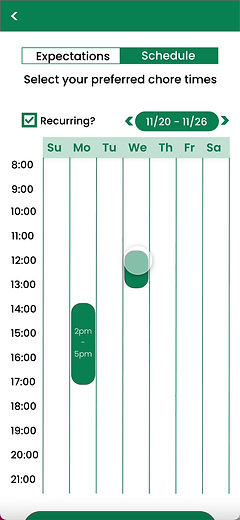
3. Each roommate also inputs their weekly availability for the chore tool to automatically assign chores

4. When all roommates have filled out their surveys, the chore tool generates a custom to-do list for each roommate

5. Roommates can view each others' chores, deadlines, quiet time requests and chore completion statuses from a shared calendar
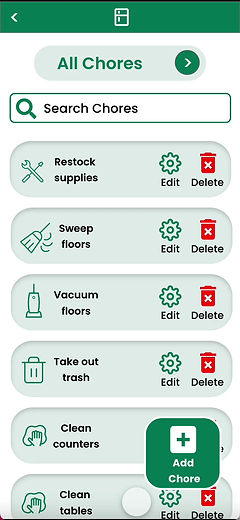
6. The "leader" (the roommate who created the virtual house) can add and edit chores to the level of specificity they like

7. Roommates can access a shared chat tool led by "Dinobot", a friendly dinosaur themed AI bot, to share household updates

8. Roommates can request periods of Quiet Time as and when they require it, and let the household know when and how many guests they want to bring via Add Guests
